
Products
Products
Steel Structure Trestle Truss
English Translation
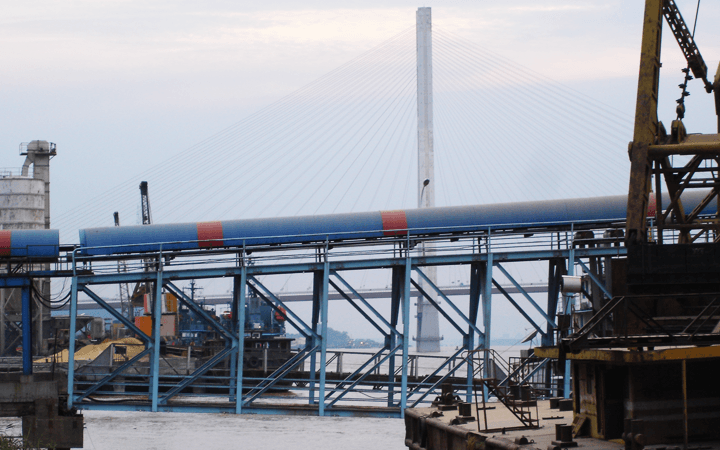
With the advancement of China’s modernization drive, industrial and mining enterprises have expanded rapidly, and steel trestles have gained increasingly extensive application, accounting for a growing proportion among all trestle structures. Especially for trestles with a height of 15 m to 20 m or above, steel trestles feature low construction cost and fast erection speed, leading to a growing variety of structural types, with a development trend toward larger span, greater height and heavier load capacity. Nevertheless, as the span, height and dead weight of steel trestles keep increasing, their installation becomes more challenging. Elaborate design is mandatory to guarantee smooth installation, which in turn facilitates further optimization and continuous innovation of structural forms for long-span steel trestles.
A truss is a geometrically invariant assembly made up of rod members. It can work as a standalone structure or act as a load-bearing unit integrated into a structural system. The generalized definition of trusses covers a wide range of engineering applications. For instance, simply supported or continuously supported vertical trusses are adopted for bridges and roof trusses; horizontally laid trusses are used for crane braking systems, wall wind bracings and belt conveyor galleries in industrial plants; transmission towers, microwave communication towers and laced columns are vertical cantilever trusses.
Members constituting steel trusses can adopt tubular cross-sections such as round tubes, rectangular or square hollow sections, rolled I-sections, H-sections, T-sections, single angles or double-angle built-up sections. Round bars can also be used as tension members in some lightweight trusses. A single truss may consist of members with different cross-sectional profiles.
Trusses generally fall into three categories: triangular trusses, trapezoidal trusses and parallel-chord trusses. Triangular trusses are commonly applied to roofs with steep slopes; trapezoidal trusses are widely used for long-span roof trusses, bridge girders and other structures; parallel-chord trusses are mostly adopted for bridge girders, support brackets and wind-resisting trusses in factory buildings.
 Internet Security Filing (Anhui PSB): No. 34088102000133