Serpentine Spring Coupling
1. Product Introduction & Application Scope
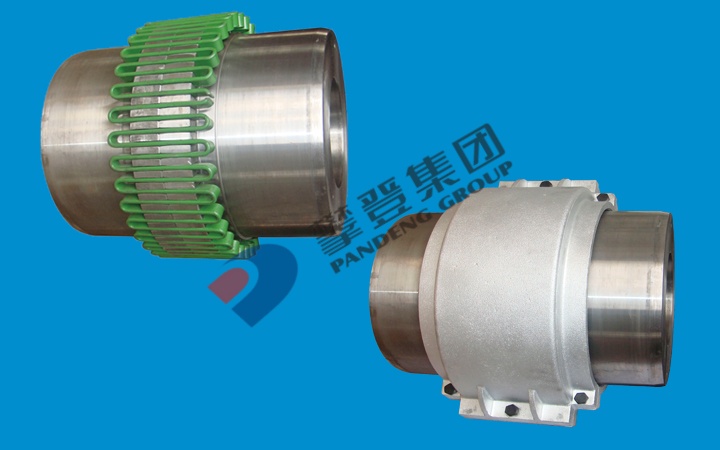
The serpentine spring coupling integrates the high torque capacity of gear couplings and the flexibility of elastic couplings, making it the simplest and most economical coupling for high-torque operating conditions. It can resist impact, damp vibration and accommodate variable loads to effectively protect equipment.
The two tooth surfaces of the serpentine spring coupling consist of multiple curved surfaces. During operation, the contact area between tooth surfaces and springs automatically adjusts with load fluctuations, enabling the coupling to withstand severe load shocks and variable loads for safer startup and uneven load conditions. In addition, the flexible transmission of springs absorbs a large amount of impact energy, reducing vibration and shock by more than 30%.
Extra-long Service Life
The conical springs are manufactured from high-strength alloy steel with strict heat treatment and precision shot peening on the surface to compact its molecular structure. This delivers an optimal balance of rigidity and flexibility, excellent fatigue resistance, superior wear resistance and an ultra-long service life.
Easy Maintenance
Fewer components, light weight and compact size simplify installation and maintenance. No regular periodic maintenance is required under normal operation. Only sufficient grease filling during initial installation is needed; the grease also absorbs part of operating noise. Simply replenish grease appropriately after long-term running.
Easy Installation & Diverse Designs
The installation precision requirement of serpentine spring couplings is lower than that of ordinary couplings. The springs can swing and float freely within the hub tooth grooves, allowing a certain amount of misalignment between two shafts without generating harmful edge loads on bearings like other coupling types.
Serpentine spring couplings are normally based on the standard T10 model. Consult our technical department for alternative designs to meet special installation requirements. Available types include: Standard T10, Standard Short Bore T10D, Axial Mounted Cover T20, Double Flange T31, Single Flange T35, Brake Disc Type T63, etc.
2. Structural Features
T10 Standard Coupling
Double-flex closed design for four-bearing systems. It adopts a horizontally split split housing matched with serpentine springs and coupling hubs. Wearing parts can be replaced without shifting connected equipment.
T20 High-speed Coupling
Double-flex closed structure with vertically split steel housing, serpentine springs and hubs, mainly applied to high-speed operating conditions.
T31 Double Flange Coupling & T35 Single Flange Coupling
The intermediate section can be detached to facilitate maintenance of bearings and seals on connected equipment, ideal for pump applications.
T45 Locking Assembly Coupling
The bore and shaft are connected via special locking assemblies for fast assembly and disassembly.
T61 Brake Drum Coupling
The braking surface is integrated on the right side of or close to the coupling shaft centerline, saving space and overall cost.
T63 Brake Disc Coupling
It outperforms drum brakes in terms of cost, structure and performance.

 Internet Security Filing (Anhui PSB): No. 34088102000133